
AI Analytics for Customer Segmentation and Retention in Australia with ACCC Compliance

Customer retention is getting harder in Australia because customers are more informed, more price sensitive, and more willing to switch. They compare plans, pause subscriptions, wait for sales, and expect brands to remember their preferences without feeling watched.
That creates a useful tension. AI and analytics can help businesses understand who is likely to buy again, who is drifting away, and what kind of offer might bring them back. At the same time, Australian businesses need to use customer data in a way that is fair, explainable, and compliant with consumer and privacy obligations.
The sweet spot is not “more data at any cost”. It is better use of the right data. That is where RFM modelling, churn signals, and practical compliance controls work well together.
In this post, we will review application of AI Analytics for customer segmentation and retention

Why customer segmentation looks different in Australia
Australian customer behaviour has its own patterns. A segmentation model copied from the US or Europe can miss local signals that matter.
Australia has high urban concentration, but also large regional and remote markets. A customer in inner Melbourne may expect same-day options and frequent promotions. A customer in regional Queensland may care more about delivery reliability, stock availability, and service continuity. Weather, school holidays, state-based public holidays, and the end-of-financial-year retail cycle can all change buying patterns.
There are also category-specific realities:
Telecommunications and utilities
Customers often show churn signals before switching, such as usage drops, complaint history, payment stress, or comparison-site activity.
Retail and ecommerce
Discount timing, delivery costs, returns, loyalty points, and stock availability can affect repeat purchase more than a generic offer.
Financial services
Segmentation must be handled with care because price, credit, hardship, and vulnerability issues may trigger extra regulatory duties.
Subscription services
Renewal friction, cancellation clarity, billing reminders, and fair contract terms matter as much as the model score.
Australian customers also tend to be sensitive to fairness. A model that gives one customer a better deal while another pays a “loyalty penalty” may appear efficient on paper, but it can create reputational and regulatory risk.
That is why AI analytics for customer segmentation and retention in Australia with ACCC compliance should start with both commercial goals and customer harm checks.
Start with RFM because it is simple, useful, and explainable
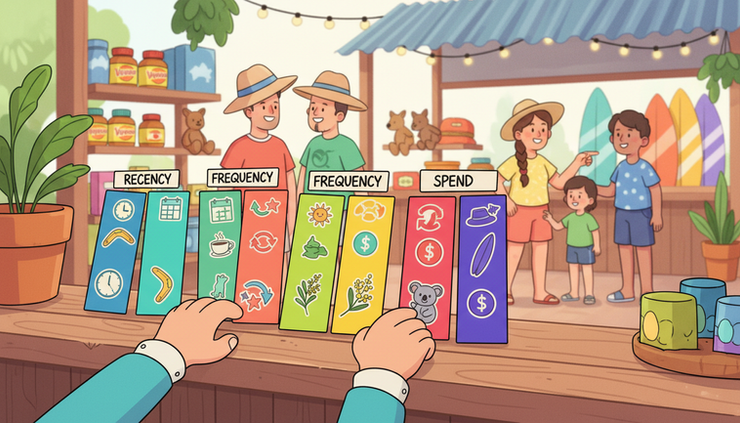
RFM stands for recency, frequency, and monetary value. It is one of the most practical ways to segment customers because it uses behaviour that most businesses already track.
RFM signal | What it measures | Why it matters |
Recency | How recently the customer bought or interacted | Recent customers are usually easier to retain |
Frequency | How often the customer buys or engages | Frequent customers often show habit and trust |
Monetary value | How much the customer spends | Higher spend can signal value, but also needs fairness checks |
A simple RFM model might score each customer from 1 to 5 for each measure. A customer with high recency, high frequency, and high monetary value may be a “champion”. A customer with high past value but low recent activity may be “at risk”. A customer with one low-value transaction may be “new” or “unproven”.
The appeal is clarity. A founder, marketer, product manager, or compliance lead can understand RFM without needing a data science background.
Useful RFM segments include:
Best current customers
They buy often and recently. The right move may be recognition, early access, or service reliability rather than constant discounts.
Promising new customers
They bought recently but not often. The next best action might be onboarding, education, or a simple second-purchase reminder.
Lapsing loyal customers
They bought often in the past but have gone quiet. They need a different message from a new lead.
Low-engagement customers
They may not justify aggressive retention spend. A light-touch campaign or preference update may be better.
High spend but high risk customers
They deserve special care. If the spend pattern relates to financial stress, gambling, hardship, or vulnerability, the business should avoid exploitative targeting.
RFM is not perfect. It does not explain why someone is leaving. It also does not capture service issues, complaints, competitor offers, or life events. That is where churn signals help.
Add churn signals to see who is likely to leave
Churn analytics looks for early warning signs that a customer may stop buying, cancel, switch provider, or reduce usage.
The best churn models combine transaction data with service and engagement data. Common signals include:
Fewer visits, logins, orders, or active days
Longer gaps between purchases
Reduced basket size or lower plan usage
Failed payments or payment delays
More returns, refunds, or complaints
Lower email or app engagement, where consent allows tracking
Cancellation page visits or downgrade attempts
Negative support interactions
Loyalty points unused for a long period
Competitor-related search or referral data, if collected lawfully and transparently
For an Australian retailer, a churn signal might be a loyal customer who usually buys every 30 days but has not purchased for 70 days. For a SaaS provider, it might be a team account where active users have dropped over several weeks. For a telco, it might be a customer who has contacted support twice, reduced usage, and viewed plan-change information.
AI can improve this process by spotting patterns that rule-based alerts miss. A machine learning model may detect that churn risk rises when service tickets and delivery delays happen close together, even if spend remains stable. It may also find different churn pathways for different customer groups.
Still, the goal is not just to predict churn. The goal is to respond in a way that is fair and useful.
A high churn score might trigger:
A service recovery check
A reminder about unused value
A plan suitability review
A delivery or fulfilment fix
A preference centre prompt
A tailored offer, where fair and lawful
A human review for sensitive cases
The best retention action is often not a discount. Sometimes it is removing a pain point.
Build segments that lead to better decisions
Segmentation fails when it creates colourful charts but no clear action. A useful segment should answer three questions:
Who is in this group?
Why does this group matter?
What should change because of this segment?
A practical model can combine RFM and churn signals like this:
Segment | Typical signals | Better retention response |
Loyal and active | Recent purchase, frequent engagement, low complaint rate | Reward reliability, ask preferences, avoid over-discounting |
Valuable but slipping | High past spend, falling activity, longer purchase gap | Check service issues, send relevant win-back offer |
New and uncertain | First purchase, low history, unknown preference | Improve onboarding and second-purchase experience |
Price sensitive | Buys mainly during promotions, low full-price purchase rate | Use clear value messages and avoid misleading urgency |
Service-frustrated | Complaints, refunds, delayed deliveries, negative support history | Fix the problem before selling more |
Possible hardship or vulnerability | Failed payments, distress signals, support notes | Use human review and care-based processes |
This approach also helps teams avoid lazy segments such as “high value” or “low value”. A customer can be high value and unhappy. Another can be low spend today but likely to grow. A third may need support rather than another promotion.
AI can also help with next best action models. These models recommend what to do next for each customer. The key is to set boundaries. A next best action system should not simply choose the message that extracts the most short-term revenue. It should consider consent, fairness, customer preferences, product suitability, and complaint history.
The Australian compliance layer cannot be an afterthought
In Australia, customer analytics sits across several legal and regulatory areas. The exact obligations depend on the industry, data used, customer type, and campaign method. This article is general information, not legal advice.
The ACCC matters because it enforces the Australian Consumer Law. For customer segmentation and retention, that can touch many areas:
Misleading or deceptive conduct
False scarcity or urgency claims
Unfair contract terms
Subscription cancellation barriers
Pricing representations
Loyalty offers that are unclear or unfair
Consumer guarantees and complaint handling
Competition issues linked to data and market power
The ACCC is also connected to the broader consumer data environment, including aspects of the Consumer Data Right. Where businesses use customer data to personalise offers or compare products, accuracy and transparency matter.
Other Australian organisations and laws may also apply:
Regulator or framework | Why it may matter for retention analytics |
OAIC and the Privacy Act | Personal information, consent, notice, access, correction, security, and Australian Privacy Principles |
ACMA and the Spam Act | Email, SMS, and certain electronic marketing consent and unsubscribe rules |
ASIC | Financial products, credit, insurance, hardship, unsuitable targeting, and disclosure |
APRA | Prudentially regulated entities and risk controls for banks, insurers, and superannuation funds |
AUSTRAC | Financial crime obligations where customer behaviour data is used in regulated sectors |
State and territory regulators | Fair trading, liquor, gambling, tenancy, and other sector rules |
Consumer Data Right | Data sharing, consent, accreditation, and use limits where applicable |
The key point is simple. A churn model is not just a technical asset. It can influence who gets contacted, what price they see, what product they are offered, and whether they face friction when leaving. Those are consumer outcomes.

Make ACCC-aligned retention fair, clear, and testable
A compliance-friendly analytics program is easier to run when the rules are designed into the workflow. The following controls help reduce risk while keeping segmentation useful.
Use clear collection notices
Customers should understand what data is collected and why. If purchase history, loyalty activity, app behaviour, or support records feed retention models, the privacy notice should say so in plain language.
Do not bury important uses in vague wording. “We use your information to improve our services” may not be enough if the business is making personalised retention offers, pricing decisions, or churn predictions.
Respect consent and communication rules
Marketing channels have different consent rules. Email and SMS campaigns need careful management under the Spam Act. Unsubscribe links must work. Preference centres should be easy to use.
Consent should also flow into the model. If a customer opts out of marketing, the retention system should not quietly route around that choice through another channel.
Avoid misleading personalisation
Personalised offers must still be true. If a message says “exclusive offer”, “last chance”, “limited time”, or “best price”, the business should be able to support that claim.
Retention teams should be careful with urgency messages, countdowns, and cancellation flows. If an AI system tests different messages, it still needs guardrails so it does not learn to use pressure or confusion.
Check for unfair outcomes
Models can treat customers differently in ways that feel unfair. For example, a business might give better prices only to customers predicted to leave, while quiet loyal customers pay more. In some industries, that may create trust issues or regulatory attention.
Fairness checks can include:
Comparing offers across customer groups
Reviewing outcomes for vulnerable customers
Testing whether postcode, age, language, or other proxies create unfair treatment
Setting rules for hardship and complaint cases
Requiring human review for sensitive decisions
Keep humans in the loop
AI can rank risk. It should not make every retention decision alone. Human review is valuable when the outcome affects price, service access, credit, hardship, cancellation, or complaints.
A clear escalation path helps. For example, if a customer has a high churn score and multiple complaint records, the next action should be service recovery, not a sales push.
Document the model
Good documentation does not need to be complex. At minimum, record:
What data the model uses
What data it excludes
The purpose of the model
How often it is updated
Who can access the outputs
What actions the model can trigger
What fairness and accuracy checks occur
How customers can ask questions or correct data
This helps with internal governance and external scrutiny.
What a practical implementation can look like
A sensible implementation starts small.
Begin with a clean customer dataset. Link transactions, product holdings, service history, consent status, and basic customer preferences. Remove data that is not needed. Flag sensitive data and restrict access.
Next, create RFM scores. This gives the business an explainable baseline. Review the segments with people who understand customers, not only analysts. Store managers, support teams, and account teams often know why a pattern is happening.
Then add churn labels. A churn event might be cancellation, no purchase after a defined period, downgrade, inactivity, or non-renewal. The definition should match the business model.
Build the first model using simple methods before moving to more complex AI. A transparent logistic regression or decision tree may be enough. More advanced models can follow once the team understands the data and risks.
Set action rules. For example:
If the customer is high value and has a recent complaint, route to service follow-up.
If the customer is new and inactive, send onboarding support if consent allows.
If the customer is loyal and active, offer recognition without training them to wait for discounts.
If the customer shows hardship signals, suppress sales campaigns and trigger a care pathway.
Run a test with holdout groups. Measure more than conversion. Track complaints, unsubscribe rates, cancellation completion, repeat purchase, customer satisfaction, and offer fairness.
Finally, review the system regularly. Customer behaviour changes. A model trained before a price rise, supply issue, or policy change may become unreliable.

The best retention systems protect trust
AI can make customer segmentation sharper, but sharper is not always better. A model that predicts churn and pushes customers into confusing offers may improve short-term numbers and damage trust. A model that spots dissatisfaction early and fixes the cause can build lasting value.
For Australian businesses, the winning approach combines:
RFM segments that people can understand
Churn signals that detect risk early
AI that recommends useful next steps
ACCC-aware controls for fairness and clarity
Privacy, consent, and communication rules built into the workflow
Human judgement for sensitive decisions
Customer retention is strongest when customers feel recognised, not profiled. Use analytics to see patterns, then use judgement to respond well. That is the difference between data-driven retention and customer relationships that actually last.
In this post, we reviewed application of AI Analytics for customer segmentation and retention. If you're looking to strengthen your business in a climate of rising inflation and interest rates, now is a good time to explore what analytics can do for you. At Insivue, we help businesses unlock efficiency and growth through tailored, data-driven solutions—whether it's optimising pricing strategies, customising service offerings, improving client relationships, tracking expenses, strengthening financial controls, or forecasting revenue with greater confidence.
A simple ROI assessment can quickly show the potential value and impact for your business. If you’re ready to move from reactive reporting to proactive decision-making, get in touch with us today—we’re here to help you find the right approach aligned with your goals.


Comments