
Why Mainstream ERP and Accounting Software No Longer Fit Modern Business Needs

The old promise of mainstream ERP and accounting software is breaking down. For years, businesses were told to buy a large platform, adapt their processes to it, train their teams around it, and accept the cost as the price of being “serious.”
That logic made sense when software choice was limited and most companies worked in similar ways. It makes far less sense now.
Modern businesses face tighter margins, heavier compliance demands, rising labour costs, inflation, supply chain pressure, and customers who expect faster service. At the same time, many firms are paying for systems packed with modules they barely touch. Teams still export data to spreadsheets. Managers still wait days for useful reports. Staff still work around the system because the system does not reflect how the business actually runs.
The problem is not that ERP and accounting software have no value. The problem is that large, generic systems often force the business to serve the software, instead of the other way around.
A better path is emerging: partner with specialist firms that can build bespoke tools around the real workflow, connect the right data, and use AI and analytics where they genuinely help. For many firms, that shift is no longer a technology preference. It is becoming a survival decision.
In this post we study why mainstream ERP and Accounting Software no longer fit modern business needs

Mainstream software was built for the average business
The biggest weakness of mainstream ERP and accounting platforms is also their selling point. They are designed to serve a wide range of industries, company sizes, tax rules, reporting needs, workflows, stock models, approval chains, and management structures.
That breadth can be useful for large organisations with complex requirements and dedicated IT teams. But for many growing businesses, it creates a different problem.
They buy a system with hundreds of features, then use a small fraction of them. The rest becomes training burden, admin noise, licence cost, and configuration risk.
A typical business may need clear answers to simple but vital questions:
Which jobs are profitable after labour, materials, overhead, and rework?
Which customers are paying late and creating cash pressure?
Which stock items are tying up money?
Which compliance tasks are due this week?
Which team or site is falling behind?
Which supplier price increases will hit margin next month?
These questions do not always need a full-scale ERP platform. They need connected data, clean workflows, useful alerts, and reporting that reflects the business model.
A generic system may be able to do some of this, but only after configuration, add-ons, consultancy, workarounds, and ongoing support. That means the business pays twice: once for the platform, then again to bend it into shape.
Unused features are not harmless
Unused software features are often treated as neutral. The thinking goes that if a module is not needed now, it might be useful later.
That sounds reasonable, but it hides the real cost.
Every extra feature adds weight. Menus become harder to navigate. Training takes longer. Permissions get more complex. Staff become unsure which fields matter. Reports include data nobody trusts. Teams create their own spreadsheets because the official workflow feels too slow.
This is how businesses end up with a strange mix of expensive software and manual work. The accounts team uses the finance module. Operations keeps a spreadsheet. Sales tracks promises in a separate tool. Managers ask for weekly reports that someone builds by hand. Compliance documents live in shared folders. No one sees the full picture until the month is over, and by then the damage has already happened.
That is not a software success story. It is a quiet margin leak.
Complex systems can hide poor performance because the effort of finding the truth becomes too high. When leaders cannot see cost, time, risk, and profit clearly, they make decisions late. In a stable market, late decisions hurt. In a high-cost market, they can be fatal.
Inflation and compliance are changing the risk calculation
There was a time when inefficiency could hide inside healthy margins. A little duplicated work, a slow monthly close, a few manual checks, and some unused software licences did not always threaten the company.
That buffer is shrinking.
Inflation raises input costs. Wage pressure increases operating costs. Customers resist price rises. Suppliers change prices more often. Tax, reporting, payroll, data protection, industry standards, and audit trails place more demand on already stretched teams.
This creates a dangerous squeeze.
Revenue may look steady, but profit weakens. Teams work harder, but admin grows. Managers push for better control, but the system does not give clear answers. The business adds more checks, more spreadsheets, and more manual approvals. That increases overhead again.
The result is a loop:
Costs rise.
Managers need better data.
The system cannot provide it quickly enough.
Staff fill gaps manually.
Admin cost rises.
Margins shrink further.
This is why software choice is now tied directly to business resilience. A system that was “good enough” five years ago may now be too slow, too broad, or too disconnected for the current environment.

Bespoke systems start with the workflow, not the software catalogue
A bespoke solution should not mean building everything from scratch for the sake of it. Good specialist firms do something more practical. They study how the business works, identify the friction, and build only what is needed.
That may include:
A custom quoting tool that calculates margin before a price is sent
A stock dashboard that flags slow-moving items
A simple compliance tracker with automatic reminders
A customer portal that reduces service calls
A job costing system connected to timesheets and purchase data
A forecasting model that shows the effect of supplier price changes
A management dashboard that combines finance, operations, and sales data
The aim is not to replace every system on day one. The aim is to remove the blind spots that cost money.
A specialist firm can often connect existing accounting tools, payment systems, stock records, spreadsheets, and operational apps. Then it can build a layer that fits the business. That approach avoids the trap of buying a huge platform just to use a narrow slice of it.
The best bespoke systems are usually simple to use because they mirror the way people already work. A warehouse team should not need to understand accounting categories to record a stock movement. A project manager should not need to wait for finance to know whether a job is drifting over budget. A director should not need five exports to see cash, sales, margin, and workload in one place.
AI and analytics matter when they solve real problems
AI is often sold badly. Too much of the discussion focuses on novelty rather than usefulness. For most businesses, the value is not in having “AI” as a label. The value is in faster decisions, fewer errors, and earlier warnings.
Used well, AI and analytics can help with everyday tasks:
Spot unusual spending patterns
Predict cash shortfalls before they bite
Flag invoices likely to be paid late
Suggest reorder points based on demand patterns
Identify jobs that are drifting away from budget
Summarise compliance gaps
Detect duplicate entries or missing documents
These are not abstract technology projects. They are practical ways to protect margin.
A large ERP vendor may offer AI features, but they often sit inside a broad product structure. A bespoke build can focus AI on the few pressure points that matter most. For example, a manufacturing firm may care about machine downtime and raw material price changes. A services firm may care about staff utilisation and project overrun. A distributor may care about stock ageing and delivery cost.
Each business has a different profit engine. The software should reflect that.

The counterargument is real, but weaker than it used to be
There is a fair argument for mainstream ERP and accounting software. Established products can bring stability, support, documentation, standard reporting, and known compliance features. For some companies, especially those with complex finance teams or strict industry requirements, a recognised platform may still be the right foundation.
The mistake is assuming that means the whole business should run inside that platform.
A modern software strategy does not have to be all or nothing. A company can keep a reliable accounting system for statutory records and financial control, while building bespoke tools around the workflows that create value.
This hybrid model is often the most sensible route. Keep the system of record where it works. Build specialist tools where the business needs speed, clarity, and fit. Connect them through secure integrations so data flows without constant rekeying.
The key question changes from “Which big platform should we buy?” to “Which parts of our business need a better tool?”
That question leads to better spending. It also reduces the risk of a huge software project that takes too long, costs too much, and still leaves staff using spreadsheets.
Bespoke does not mean uncontrolled
Some leaders worry that custom software will create dependence on one supplier, lack support, or become hard to maintain. Those risks are real when a build is poorly planned.
A good specialist firm should reduce those risks from the start. That means clear documentation, sensible architecture, secure access controls, data backups, testing, and a plan for future changes. It also means using proven technologies rather than obscure tools that only one developer understands.
Strong bespoke work should include:
Clear ownership of data
Plain-language documentation
Secure user permissions
Audit trails for key actions
Integration with existing finance records
A roadmap for improvements
Training that fits each role
Support agreements that match business needs
Bespoke software should make the business less fragile, not more fragile.
The right partner will also challenge the brief. If an off-the-shelf tool is enough for a task, they should say so. If a process is broken, they should not automate it blindly. If data quality is poor, they should fix the foundations before adding dashboards.
That honesty is one of the main reasons to work with specialists. They are not trying to sell every module in a catalogue. They are trying to build the right tool for the job.
The real cost is delay
The case for bespoke systems becomes strongest when looking at what happens if nothing changes.
A business that cannot see margin clearly will keep accepting poor work. A business that cannot track compliance easily will spend more time reacting. A business that cannot forecast cash pressure will negotiate from weakness. A business that cannot connect operations and finance will keep finding problems too late.
None of these failures usually arrives as one dramatic event. They build slowly.
A few late invoices. A few underpriced jobs. A few missed supplier increases. A few staff hours lost each week to manual reporting. A few compliance tasks handled in panic. A few customers lost because service slowed down.
Then inflation rises again, a key supplier changes payment terms, or a competitor offers faster service with lower overhead. The margin that once absorbed inefficiency is gone.
The businesses most at risk are not always the ones with no software. They are often the ones with expensive software that gives them a false sense of control.
That is the danger of top-heavy systems. They look mature from the outside, but inside the business they may be slowing decisions, hiding costs, and draining attention.
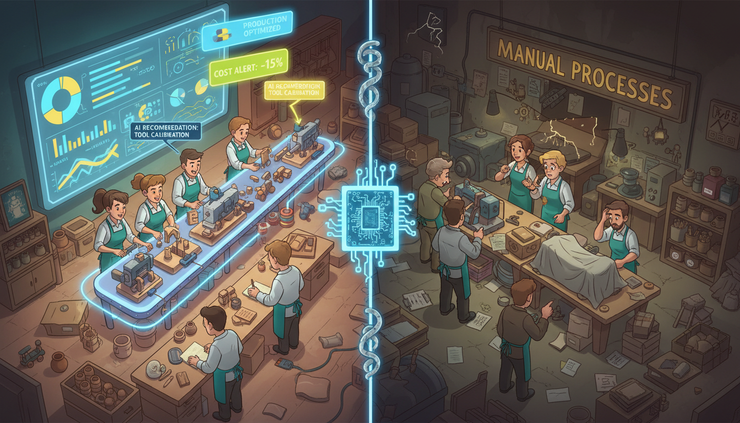
The future belongs to lighter, smarter systems
Mainstream ERP and accounting platforms are not disappearing overnight. They will keep serving many businesses, especially where standardisation matters more than flexibility.
But for a growing number of firms, they no longer fit the way work gets done. They are too broad, too slow to adapt, and too costly when only a small part of the system creates daily value.
The better approach is more focused. Keep what works. Remove what slows people down. Build the tools that reveal margin, reduce manual effort, and support compliance before it becomes a crisis. Use AI and analytics where they answer real business questions, not where they look impressive in a demo.
Software should make the business sharper, faster, and easier to control. If it does not, the cost is bigger than the licence fee. It shows up in missed margin, slow decisions, tired teams, and risk that arrives too late to fix.
Businesses do not need heavier systems. They need systems that fit. Those that make that shift now will have a better chance of protecting profit in a tighter market. Those that wait may find that their software did not save them from pressure. It helped hide the pressure until there was no room left to move. In this post we learned why mainstream ERP and Accounting Software no longer fit modern business needs. If you're looking to strengthen your business in a climate of rising inflation and interest rates, now is a good time to explore what analytics can do for you. At Insivue, we help businesses unlock efficiency and growth through tailored, data-driven solutions—whether it's optimising pricing strategies, customising service offerings, improving client relationships, tracking expenses, strengthening financial controls, or forecasting revenue with greater confidence.
A simple ROI assessment can quickly show the potential value and impact for your business. If you’re ready to move from reactive reporting to proactive decision-making, get in touch with us today—we’re here to help you find the right approach aligned with your goals.


Comments